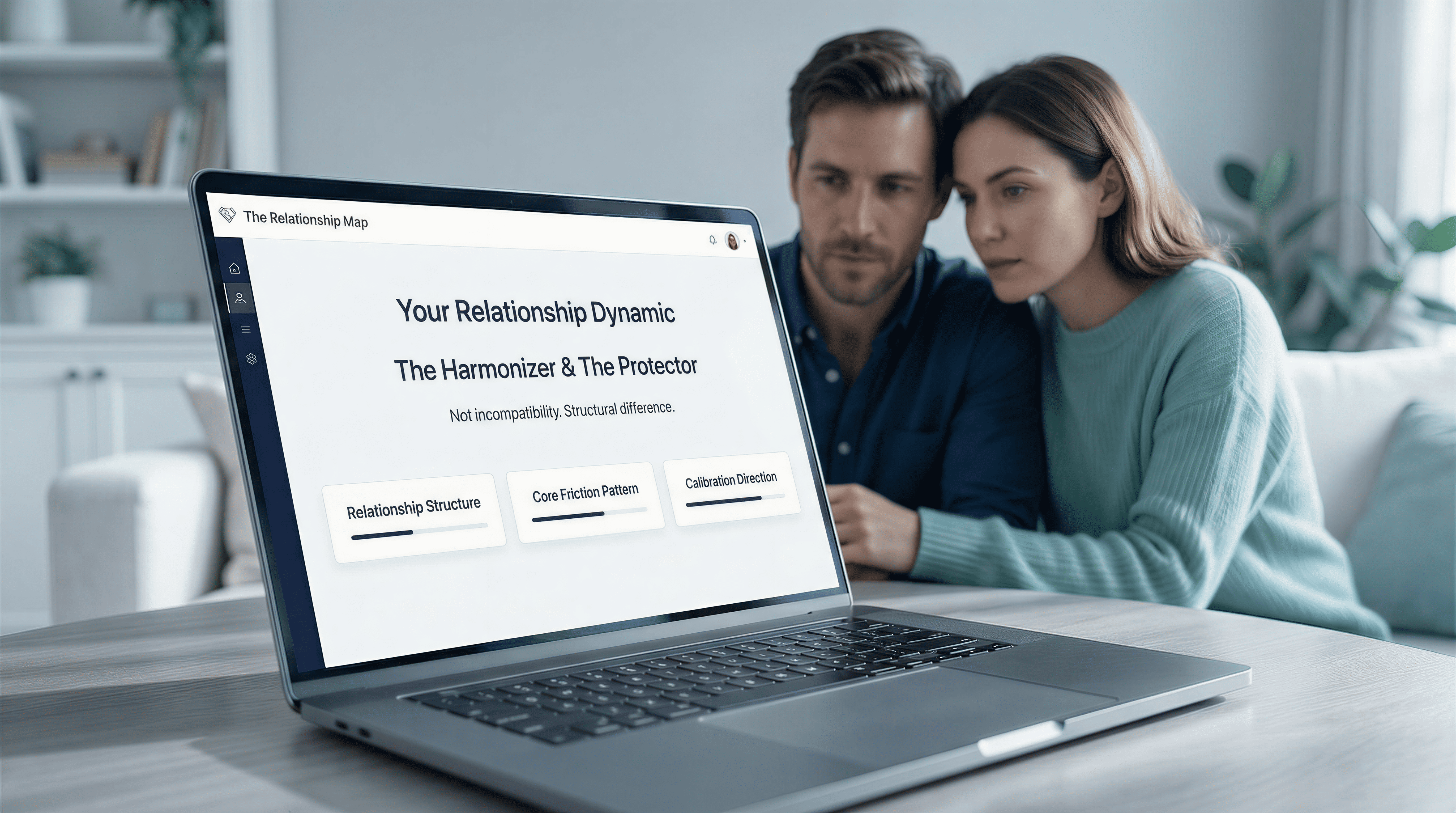
Discover the hidden structure behind your relationship dynamic

Our Relationship Map reveals the hidden patterns shaping how you and your partner interact.

A structured framework that maps the behavioral patterns, reduces conflict, and deepens connection between partners.
Not advice. Not therapy. Built for clarity.

© Developed by the Relationship Intelligence Institute

Generate Your Relationship Map
Private
Self-guided
~10 minutes
👥Trusted by 25,000+ couples
4.8 average rating

These Moments May Feel Familiar

Many couples experience these moments not because something is wrong — but because each partner reacts from a different emotional driver.

You may recognize moments like these.

Why This Happens

Underneath these reactions are different emotional priorities.

Partner A
Emotional Driver
Need for Security
Reaction
Seeks Reassurance
MISMATCHMOMENT
Partner B
Emotional Driver
Need for Autonomy
Reaction
Creates Space

These patterns are rarely random.
They follow a predictable interaction structure.

When we don't have a map for these patterns, we get lost in the emotional wilderness.
We react instead of responding. We defend instead of connecting.

Every Couple Has a Pattern.
Most Have Never Seen It.

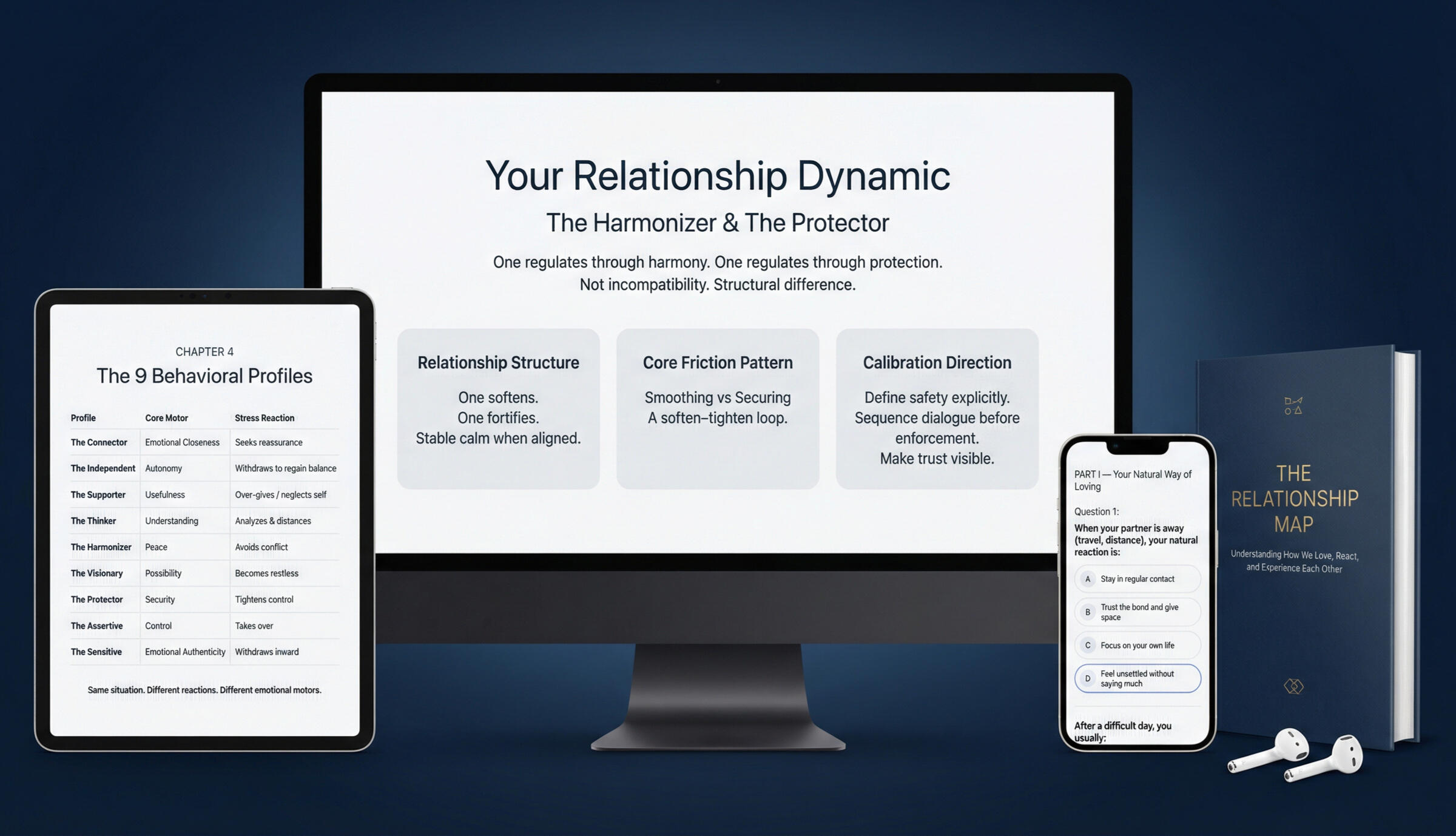
Each person operates from a behavioral profile. When two profiles meet, they create a predictable dynamic — with its own friction points, its own blind spots, and its own recurring tension.

9 Relationship Profiles

01Anchor
02Connector
03Explorer
04Thinker
05Harmonizer
06Visionary
07Protector
08Sensitive
09Assertive

The Relationship Dynamic

Every pair of profiles generates a relationship dynamic — a specific interaction structure that determines how two people understand each other, misread each other, and why certain moments keep repeating.

Some combinations create natural alignment. Others create a pattern — one that keeps repeating not because something is wrong, but because the structure hasn't been mapped yet.

This isn't incompatibility. It's structure.

The Relationship Map was built to decode that structure.

The System

The Relationship Map

Diagnostic Framework

A structural diagnostic framework that maps the exact interaction dynamic your two profiles create together — where your emotional logics diverge, where you align, why the same tension keeps recurring, and what to adjust.

Clarity first. Direction follows.

Most couples feel the pattern.
The Relationship Map lets you see it.

Here is how it works — in three steps.

Complete System

What You Get

Three steps reveal the structure behind how you interact as a couple.

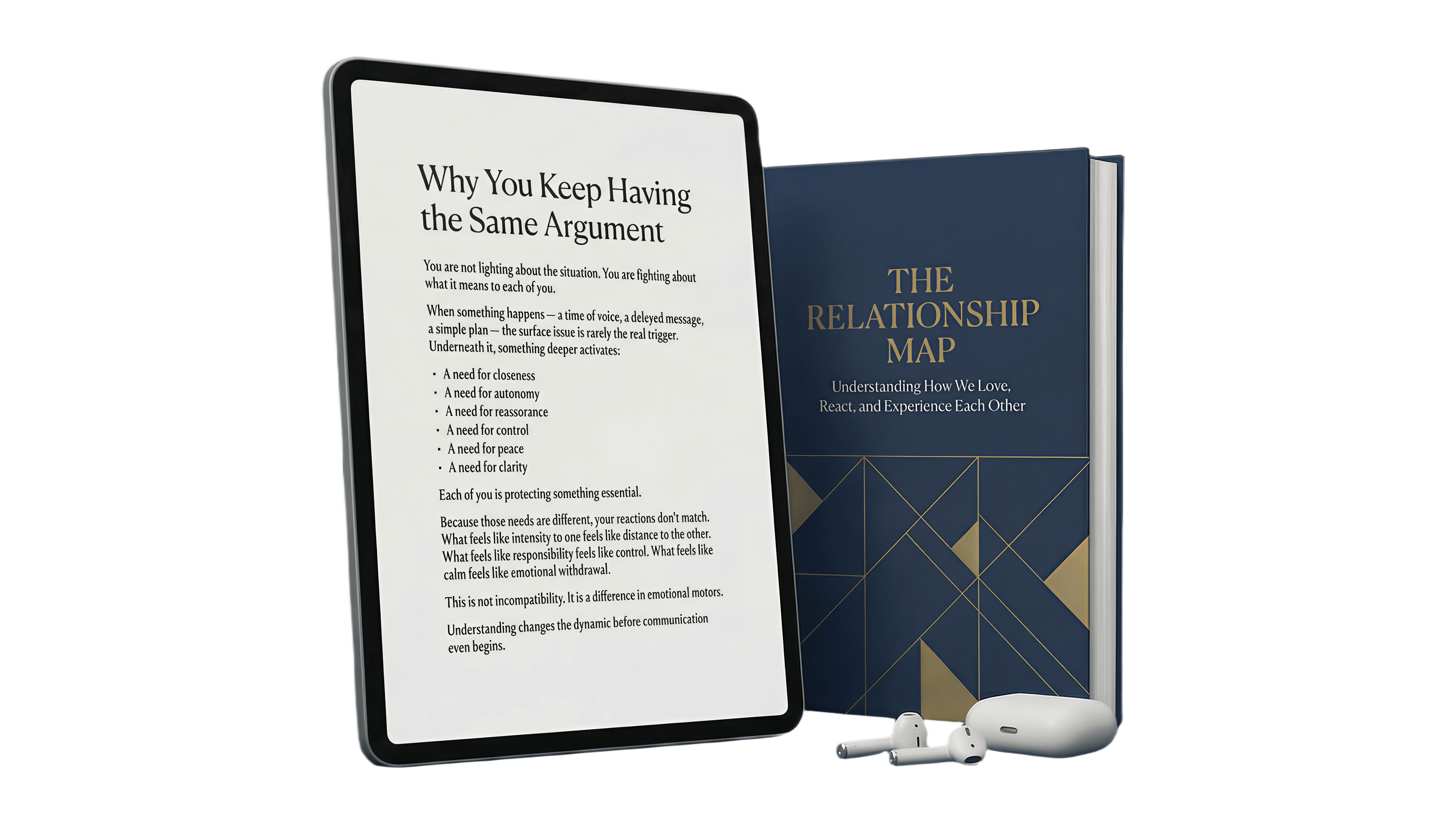
The Relationship Map Playbook
1
Understanding
The Relationship Map Playbook
Finally — a Map for What Keeps Happening

Most couples don't have a communication problem. They have a pattern problem — and no map to read it. The Playbook gives you that map. Once you see the structure, the dynamic stops feeling personal. And once you can name it, you can start to shift it.

9 behavioral profiles — each driven by a distinct emotional logic and stress response
The interaction structure — why two people in the same moment experience it completely differently
Pattern recognition — name what's happening, then know what to adjust
Playbook sample below
Playbook Preview
Read Before You Buy.
"Chapter 4 alone was worth the price. I finally understood why my wife needs space — it's not rejection, it's regulation."
✦ Marcus T., Sydney

Two chapter extracts

📖 Chapter 1⏱ ~4 min read
Chapter 1
Why Love Is Not Always Enough

Most couples don't struggle because they don't love each other.
They struggle despite loving each other. This can feel confusing — even unfair.

"If we love each other, why is this still hard?"
"If our intentions are good, why do we keep hurting each other?"

Love Does Not Automatically Mean Understanding

Love creates attachment, care, and emotional connection.
But love does not automatically create understanding. Two people can love each other deeply, want the relationship to work, make real efforts — and still misunderstand each other again and again.

Why? Because love does not determine how we react under stress, express needs, interpret silence, or respond to the same situation.
Those things are shaped by something else.

Conflicts Often Happen Despite Good Intentions

Many conflicts don't start with bad intentions. They start with moments like:

  • "I just wanted to give them space."
  • "I was trying to help."
  • "I thought that was what they needed."

Both people are sincere — and both feel hurt. This is where frustration grows: "I'm doing my best, and it's still wrong."

Why Making More Effort Doesn't Always Fix the Problem

When tension appears, most people respond by trying harder. They explain more, give more, adapt more, or withdraw to avoid conflict. Sometimes this helps. Often, it doesn't.

Because the issue is not the amount of effort — it's the direction of the effort.
You may be giving what you would need in that situation, while your partner needs something completely different.

More effort in the wrong direction can increase misunderstandings, create exhaustion, and lead to resentment.
Not because you don't care — but because you are speaking different emotional languages.

A Shift in Perspective

What if the recurring tensions in your relationship were not a sign of a lack of love, incompatibility, or failure — but the result of different ways of perceiving and reacting?

  • The same situation does not feel the same to both of you
  • The same gesture does not send the same message
  • The same silence does not mean the same thing

This playbook is built on that idea.
That's where we're going next.
📖 Chapter 7⏱ ~5 min read
Chapter 7
Adapting to the Other Without Losing Yourself

By now, something important has shifted.
You no longer see conflicts as simple disagreements.
You no longer see reactions as personal attacks.

And a quieter realization may have appeared:

"Maybe we're not broken. Maybe we're just wired differently."

That realization naturally leads to a delicate question — often unspoken:
If we are different… who has to adapt?

This chapter answers that question clearly, calmly, and without guilt.
Because adaptation is one of the most misunderstood — and most misused — ideas in relationships.

Adaptation Is Not Sacrifice

Many people believe that adapting means giving something up — their needs, their rhythm, parts of themselves to keep the relationship alive.
That kind of adaptation doesn't build love. It builds resentment.

True adaptation is not about disappearing. And it is not about asking your partner to disappear either.

Real adaptation does not ask: "How do I stop being myself?"
It asks: "How can I stay myself in a way the other can receive?"

Identity vs. Behavior: A Crucial Distinction

This distinction changes everything.

Your emotional motor — what helps you feel safe, connected, or grounded — is part of your identity.
It is not something you negotiate away.

What is adjustable is how that motor expresses itself: the timing, the wording, the intensity, the format.

BEHAVIORtiming · wording · intensity · formatadjustableMOTORyour neednon-negotiable

A Connector does not stop needing closeness. An Independent does not stop needing space.
But both can learn how to signal those needs without activating the other's protection mode.
This is where adaptation becomes intelligent — not painful.

What Is Negotiable (and What Is Not)

What is NOT negotiable: your core emotional motor, your fundamental need for safety, your inner limits.
Suppressing these leads to frustration, emotional fatigue, and withdrawal over time.

What IS negotiable: when you speak, how you speak, how strongly you express something, whether you choose reassurance, explanation, or action.

You don't negotiate who you are.
You negotiate how you show it.

Adapting to Your Partner's Motor

Here is the central principle of this chapter:

You adapt to the motor, not to the personality.

When you understand what makes your partner feel safe, adaptation becomes precise — not personal.

Here is what that difference looks like in practice:

Adapting to the personality vs. Adapting to the motor

Adapting to the personality: "They're always so distant. I'll just stop reaching out."

Adapting to the motor: "Their Independent motor needs space to recharge. I'll give them room — and let them know I'm here when they're ready."

Same situation. Completely different response.
One closes down. The other opens a door.

Dual Self-Assessment
2
Diagnosis
Dual Self-Assessment
Your Behavioral Profile. Independently Mapped.

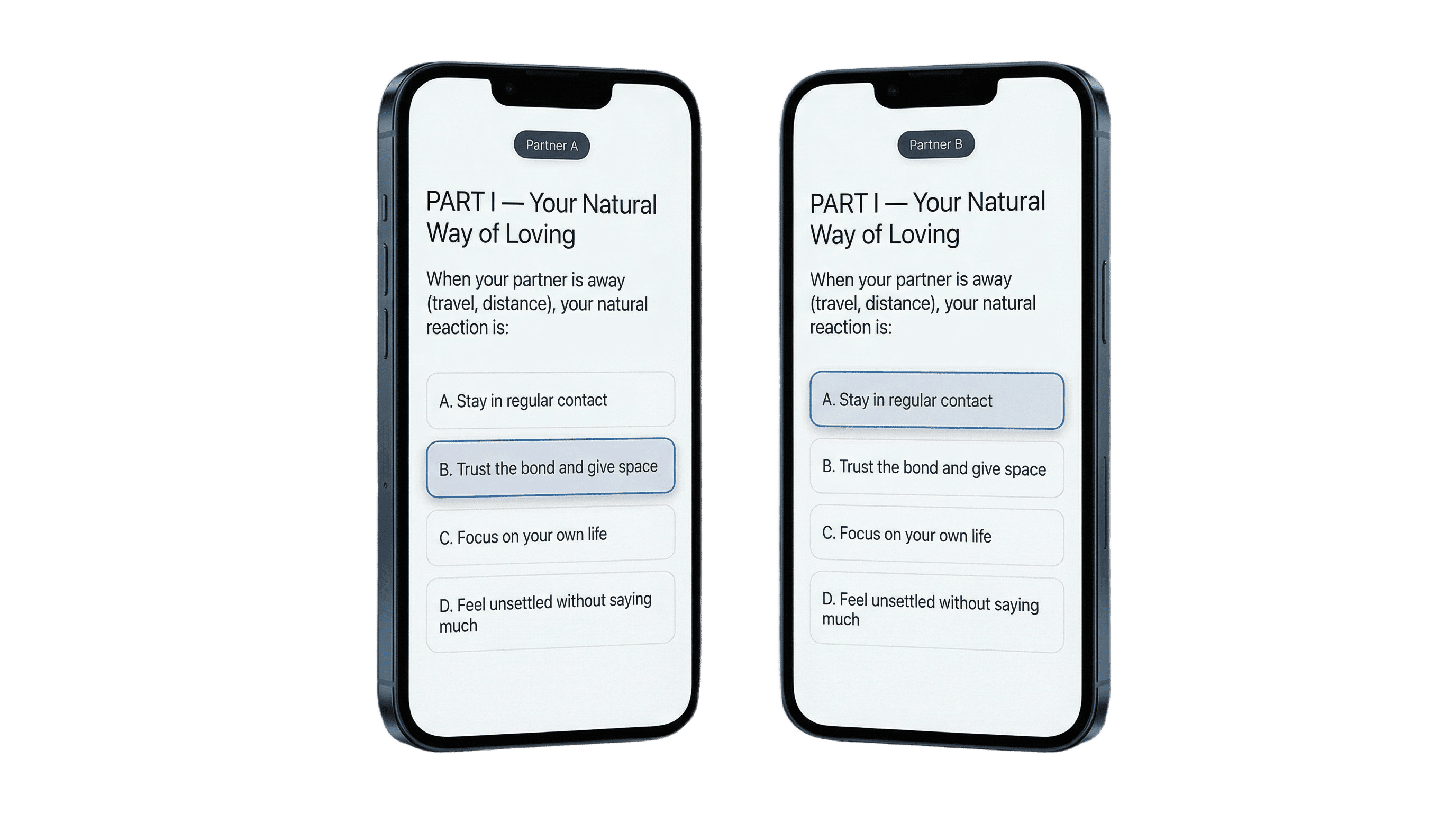
Each partner completes their own assessment independently. Private responses produce precise results. If your partner isn't ready, you can also complete your own assessment and provide your perception of how they typically react — the system generates your Map either way.

Not a personality quiz — a behavioral diagnostic that maps how you actually interact.
~10 minutes per partner — scenario-based, behaviorally grounded questions
Identifies your emotional logic — how you connect, react under stress, and where misunderstandings are most likely to happen
No right or wrong answers — the more honest you are, the more accurate the Map
Your Personalized Relationship Map
3
Direction
Your Relationship Map
Where Everything Becomes Clear

You've felt the pattern. This is where you finally see it. Your Map is generated from both profiles and reveals the exact interaction structure your dynamic creates — not a description of your personalities, but a precise read of how your two behavioral patterns work together, where they create tension, and why.

Your interaction dynamic — the structural pattern your two profiles generate together.
Your core friction zone — the exact point where your emotional logics diverge. Why it keeps happening — and what triggers it each time.
Calibration direction — targeted adjustments derived from the structure of your specific dynamic.

Ready instantly. Clear from the first read.
Most couples say it's the first time their dynamic actually made sense.

What Couples Are Saying

Heard From Those Who Mapped It.

From couples who finally understood what was happening between them.

★★★★★
4.8 out of 5 · Based on 25,000+ couples
"
★★★★★

The comparison section between our two profiles was like reading a case study about us :) Accurate & structured. We were both impressed.

Lena P.
Lena P.
Dubai, UAE
Verified
"
★★★★★

We'd been circling the same issues for two years. This gave us a shared language we never had. Now when tension rises, we name the pattern instead of blaming each other.

Kevin M.
Kevin M.
Calgary, AB
Verified
"
★★★★★

I'm a therapist. I recommended this to three couples in the same week. The behavioral framework is the clearest I've seen outside clinical tools — and far more accessible.

NB
Dr. Nadia B.
Edinburgh, UK
Verified
"
★★★★★

The comparison section between our two profiles was like reading a case study about us :) Accurate & structured. We were both impressed.

Lena P.
Lena P.
Dubai, UAE
Verified
"
★★★★★

We'd been circling the same issues for two years. This gave us a shared language we never had. Now when tension rises, we name the pattern instead of blaming each other.

Kevin M.
Kevin M.
Calgary, AB
Verified
"
★★★★★

I'm a therapist. I recommended this to three couples in the same week. The behavioral framework is the clearest I've seen outside clinical tools — and far more accessible.

NB
Dr. Nadia B.
Edinburgh, UK
Verified
"
★★★★★

I used it alone — my partner wasn't ready. The Playbook and my assessment gave me enough clarity to stop taking the conflict personally. That reframe alone was worth it.

James T.
James T.
Austin, TX
Verified
"
★★★★★

The Playbook alone was very eye-opening. Thank you RII for this bijou.

Sophie & Marc
Sophie & Marc
London, UK
Verified
"
★★★★★

11 years together and we had a blast going through this. We kept laughing at how accurately it described each of us. Turns out we now know exactly what triggers the other — and we use it wisely 😄

Diana K.
Diana K.
Toronto, ON
Verified
"
★★★★★

I used it alone — my partner wasn't ready. The Playbook and my assessment gave me enough clarity to stop taking the conflict personally. That reframe alone was worth it.

James T.
James T.
Austin, TX
Verified
"
★★★★★

The Playbook alone was very eye-opening. Thank you RII for this bijou.

Sophie & Marc
Sophie & Marc
London, UK
Verified
"
★★★★★

11 years together and we had a blast going through this. We kept laughing at how accurately it described each of us. Turns out we now know exactly what triggers the other — and we use it wisely 😄

Diana K.
Diana K.
Toronto, ON
Verified
"
★★★★★

We had the same argument for three years. After seeing our profiles, my partner said: "I wasn't trying to control you. I was trying to feel safe." That sentence changed everything.

Sarah L.
Sarah L.
Vancouver, BC
Verified
"
★★★★★

I was skeptical. We'd done therapy, read books. But this showed us why we kept doing the same thing — not just what to do. Worth every dollar.

Alex M.
Alex M.
New York, NY
Verified
"
★★★★★

The friction section described our last six months almost word for word. I didn't expect to cry reading a report. But I finally felt understood.

Amélie C.
Amélie C.
Montreal, QC
Verified
"
★★★★★

We had the same argument for three years. After seeing our profiles, my partner said: "I wasn't trying to control you. I was trying to feel safe." That sentence changed everything.

Sarah L.
Sarah L.
Vancouver, BC
Verified
"
★★★★★

I was skeptical. We'd done therapy, read books. But this showed us why we kept doing the same thing — not just what to do. Worth every dollar.

Alex M.
Alex M.
New York, NY
Verified
"
★★★★★

The friction section described our last six months almost word for word. I didn't expect to cry reading a report. But I finally felt understood.

Amélie C.
Amélie C.
Montreal, QC
Verified

How the Relationship Map Works

From behavioral patterns to interaction structure

Relationship Playbook
Step 1
A concise framework explaining the 9 behavioral profiles that shape how people react, communicate, and interpret each other.
Note: Many couples prefer to read the Playbook after completing their assessments — both approaches deliver the same value.
Dual Assessment
Step 2
Partner A  /  Partner B Each completes a short private questionnaire independently — identifying their emotional drivers, natural relationship patterns, and behavioral profile.
Relationship Map Engine
Step 3
The system cross-references both profiles to reveal where your interaction patterns align — and where friction appears.
Your Relationship Map
Outcome
A personalized report revealing both profiles, your interaction dynamic, and the structure behind recurring tensions.

The entire process takes about 10 minutes per partner.

What You Will Discover
Inside Your Relationship Map

Discover your profiles — and the dynamic they create together.

Your report reveals the structure your two profiles create — how your patterns interact, where tension appears, and how your relationship dynamic evolves over time.

01Your individual profiles
Your dominant motor, behavioral logic under stress, what you each need to feel safe — mapped independently for each partner.
02Your relationship dynamic
The exact structure your two profiles create together — named, mapped, and explained. Not a description of your personalities, but of the interaction they generate.
03Natural strengths
What already works between you — and why the contrast between your profiles creates depth when it is not under pressure.
04Friction zones — step by step
Where misunderstandings are most likely — and how the loop activates. The mechanism mapped precisely so you can see it coming before it escalates.
05Blind spots
What each of you cannot see from inside your own motor — how your natural reactions land differently on the other side.
06Calibration strategies
Targeted adjustments derived from the structure of your specific dynamic — not generic advice, but directions built for your exact pairing.
07Navigation principles
Practical signals and language to interrupt the loop before it escalates — usable in real moments, built for your dynamic.
Sample report below
Sample Report
This is what clarity looks like.
Sarah & James · Connector × Independent · The Pursuit Dynamic
"We kept looking at each other saying — how does it know that?"✦ Claire M., Austin TX
View Sample Report
12 pages · Connector × Independent · Private & Confidential
Close Report
The Shift

What Changes When You See the Pattern

1
From Blame to Understanding
It depersonalizes the conflict.
Before"You are doing this to hurt me."
After"We are caught in Pattern B again."
2
From Reacting to Choosing
Seeing the map gives you a pause button.
You can choose a new route instead of automatically going down the path of escalation.
3
From Mystery to Clarity
Confusing behaviors suddenly make sense.
You understand the "why" behind the actions, fostering deep empathy.
4
From Isolation to Teamwork
The problem becomes the pattern, not the partner.
You unite against the dynamic rather than fighting each other.

When the pattern becomes visible, the relationship becomes easier to navigate — not because everything changes, but because you're finally working with the right information.

Who this is for
You're a good fit if
You love your partner — and still feel like something keeps missing
You've had the same argument more than once and don't fully understand why
You want clarity about your dynamic — not just advice about what to do
You're ready to understand before you try to fix
This works whether
Your relationship is under tension — or simply not as close as it used to be
Both partners are ready — or just one of you wants to understand
You've tried therapy, books, or conversations — and still feel stuck
Everything looks fine on the outside but something feels off inside
This is not
A personality test or entertainment quiz
Generic relationship advice or vague tips
A replacement for therapy or professional care
A verdict on your relationship or your partner
It's a diagnostic tool — not a judgment.

The Relationship Map maps your dynamic precisely so you can see the structure behind what's happening. Understanding comes first. Direction follows.

Before You Begin

What you need to know

Honest answers to the questions most people have before starting.

The questions that matter most
Should we read the Playbook before or after the Map?
Both are included and delivered together. Most people start with the Map — it reveals your dynamic immediately. The Playbook explains the framework behind it. No order required.
Will this actually be specific to us — or is it a generic profile?
Every section is generated from your two profiles combined — not a template. Two couples with the same dominant profile receive completely different reports. There is no generic version.
What if my partner isn't ready yet?
Not a problem. One partner can complete a self-assessment and a perception assessment of the other. This produces reliable results — the assessment is behaviorally grounded, making perception-based inputs just as valid. Many couples choose to start this way.
Is this therapy?
No. It is a diagnostic tool — it names patterns and creates clarity. No sessions, no ongoing support. If you are navigating a serious mental health situation, professional support remains the right path.
More questions
How is this different from MBTI, Enneagram, or other personality tests?
Personality tests map who you are. The Relationship Map maps what happens between you — the pattern that emerges when two profiles interact under pressure. Not traits. Mechanisms.
Who sees our answers? Is this confidential?
Your answers are used solely to generate your report. They are not shared, sold, or used for any other purpose. The report is delivered privately to the email you provide. No one else sees your responses — including your partner's answers, which are processed separately.
Do we take the assessment together or separately?
Separately — and intentionally so. Each partner completes their assessment independently, in private, without seeing the other's answers. This is what makes the Map accurate: both profiles are captured without influence. Once both assessments are submitted, the system generates your combined report automatically.
What if our profiles are very different?
Different profiles are not a problem — they are the most useful input. The Relationship Map is specifically built to make sense of contrasting profiles. In most cases, significant differences explain recurring patterns more precisely than similarities do. The goal is not compatibility. It is clarity.
How long does the assessment take?
Each assessment takes 10 to 15 minutes. The questions are direct — there are no right or wrong answers, only honest ones. Your Relationship Map is generated and delivered within minutes of both assessments being submitted.
Is this a subscription?
No. One payment. Permanent access. You receive your personalized Relationship Map and the full Relationship Playbook — no recurring charges, no account required after delivery.

Still have a question? Write to us at [email protected] — we respond within 24 hours.

Your Investment

One framework.

Lasting clarity.
$197$97
One-time payment · No subscription
Discover your behavioral profiles
Understand the dynamic they create together
See the deeper structure behind your interactions
Your personalized Relationship Map — generated instantly in 10 min.
Generate Your Relationship Map — $97
Couples Therapy
$200/session
No framework
No behavioral map
No personalized report
The Relationship Map
$97 one-time
Full framework
Dual assessment
Personalized report

The Relationship Map Framework

© Relationship Intelligence Institute. All rights reserved.